

Let’s be honest: when you hear “administrative job,” the first image that pops into your head is probably someone answering phones and filing papers. That stereotype is not just outdated—it’s a complete misunderstanding of what modern administration truly involves.
Over 1.5 million people work in administrative roles across the public services sector alone in the UK , and the numbers in India are exponentially larger. From multinational corporations to government ministries, administrators are the silent engines that keep organizations running.
More Than Just Clerical Work
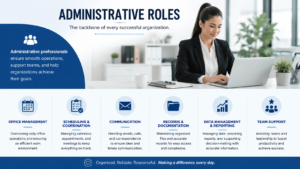
Administrative professionals facilitate the smooth operations of departments by managing communication, record-keeping, and office systems . But the scope of work has expanded dramatically. Today’s administrators are:
- Strategic partners who manage budgets, coordinate projects, and oversee teams
- Technology experts proficient in Microsoft Office 365, Teams, SharePoint, and specialised software
- Crisis managers who handle tight deadlines, fast-paced environments, and high-pressure situations
The Career Ladder: From Assistant to Executive
Administration is a hierarchical field with multiple entry points and clear career progression. Here’s a glimpse of the spectrum:
Your Degree Opens Doors
A postgraduate qualification significantly boosts your prospects in the administrative field. While many entry-level positions accept 10th or 12th pass candidates, the highest-paying and most strategic roles require a graduate or postgraduate degree.
Government Administrative Opportunities
For those eyeing the public sector, there are excellent administrative roles with exceptional pay and stability. Positions like EPFO Social Security Assistant and SSC CGL (Group B and C posts) are open to graduates . The salary for these roles ranges from approximately ₹55,000 to ₹80,000 per month, depending on the grade pay . These positions typically involve:
- Handling public and inter-departmental enquiries
- Managing operational caseloads and maintaining records
- Researching and producing reports
Private Sector and Corporate Roles
The private sector offers a different kind of opportunity—higher packages, faster growth, and exposure to global standards.
- Senior Administration Manager: A top-tier role requiring a Bachelor’s or Master’s degree in Business Administration and 15+ years of experience . The job involves managing office operations, vendor contracts, IT coordination, and facilities management, often in a hybrid work model .
- Administration Manager or Zonal Administration Manager: Responsibilities include team leadership, budget management, vendor services, and compliance management, particularly in banking or corporate environments .
- Executive Assistant: Provides high-level support to senior leaders, managing schedules, preparing reports, and coordinating meetings . This role requires strong organizational and communication skills and can be a stepping stone to management positions.
Top Skills Employers Are Looking For
To excel in administration, you need more than just a degree. A review of major job portals reveals that employers consistently seek candidates with:
- Strong organizational abilities: Multitasking, time management, and attention to detail are non-negotiable
- Excellent communication: Written and verbal skills for interacting with colleagues, clients, and vendors
- Technical proficiency: Experience with Microsoft Office Suite (Word, Excel, PowerPoint) is a baseline requirement
- Leadership and team management: For supervisory and managerial roles
- Budget and vendor management: Essential for mid-to-senior roles
Your Next Steps
- Assess Your Degree: A postgraduate degree can give you an edge for roles that require strong analytical and management skills.
- Build Your Profile: Proficiency in MS Office, excellent communication, and organizational skills are just as important as your degree .
- Identify Your Sector: Government roles offer stability, while private roles often provide higher packages and faster growth.
- Start Applying: Watch for notifications from organizations like SSC, IBPS, and EPFO for government jobs , and use major job portals to find corporate openings.
The world of administration is dynamic, rewarding, and integral to every industry. Your postgraduate degree is your passport to this world.